
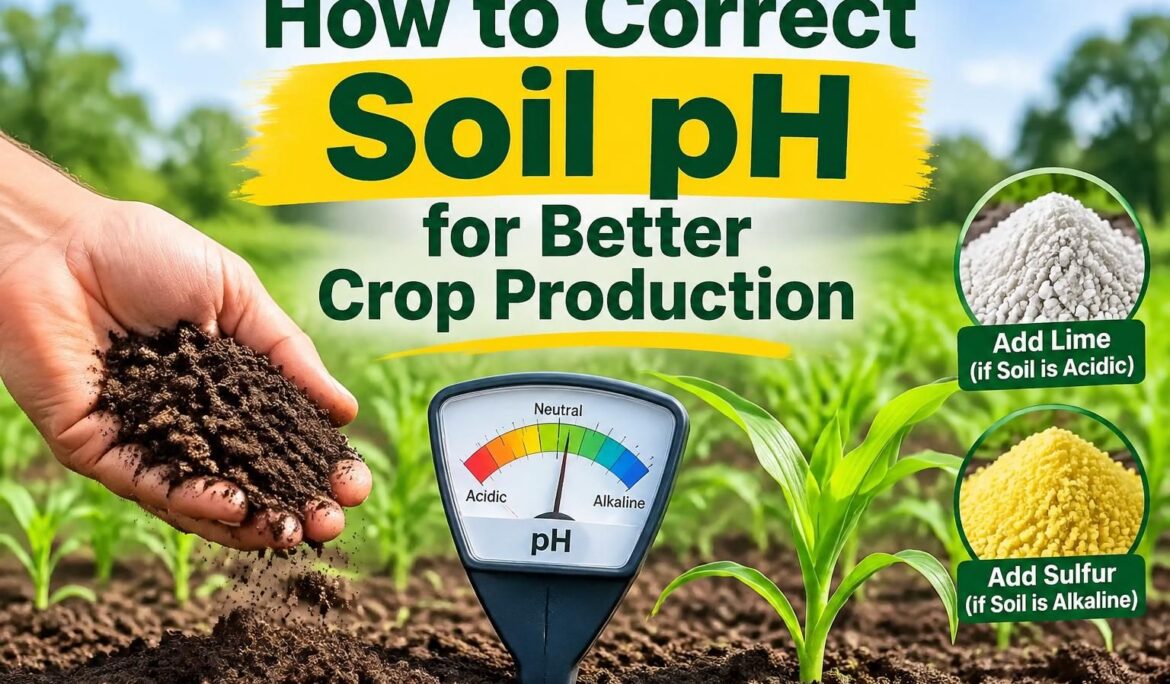
Correcting soil pH starts with a representative soil test, not a guessed lime rate. Soil pH shows how acidic or alkaline the soil solution is, but the amount of amendment required also depends on soil texture, clay content, organic matter, exchangeable acidity, crop requirements and the quality of the liming material.
For farmers, the practical goal is not to achieve a universally perfect pH. It is to move each field into a suitable range for the intended crop while correcting constraints such as aluminium toxicity, calcium or magnesium shortages, poor nutrient availability and restricted root development. Because fields are rarely uniform, sampling and treating management zones separately can produce a more reliable result than applying one rate across an entire farm.
For bulk agricultural Lime or Gypsum, contact Kalkor.
Specialist agricultural lime and gypsum support
Kalkor supplies bulk agricultural minerals for commercial soil amendment programmes. Farmers and advisers can review the agricultural product list, explore the available soil amendment products, visit the Kalkor website or contact the Kalkor team for product assistance. Product selection and application rates should be based on a recent laboratory analysis and an agronomic recommendation for the field.
What soil pH tells you about a field
Soil pH is a logarithmic measure of acidity or alkalinity. A pH below 7 is acidic, a pH of 7 is neutral and a pH above 7 is alkaline. Because the scale is logarithmic, a change of one pH unit represents a tenfold change in hydrogen-ion activity. That does not mean that moving a soil from pH 5 to pH 6 requires a standard quantity of lime. Two soils with the same measured pH can have very different lime requirements.
The pH result measures active acidity in the soil solution at the time of testing. Much of a soil’s acidity may be held on clay and organic matter exchange sites. This reserve acidity resists change and is one reason a clay soil generally requires more liming material than a sandy soil to achieve the same pH movement.
Laboratory methods also matter. Results obtained using water may differ from results obtained using a salt solution such as potassium chloride. Farmers should not compare numbers from different methods as though they were identical. The target range and recommendation must be interpreted according to the test method reported by the laboratory.
How incorrect pH reduces crop performance
Soil pH affects nutrient reactions, microbial activity, root growth and the behaviour of potentially toxic elements. A crop may receive enough fertiliser on paper yet struggle to use it because the root zone remains chemically restrictive.
In strongly acidic soils, soluble aluminium and manganese can reach concentrations that damage sensitive roots. Aluminium toxicity often produces short, thickened or poorly branched roots. A restricted root system explores less soil, absorbs less water and is less able to withstand dry periods. Acid conditions may also reduce the effective availability of phosphorus, calcium, magnesium and molybdenum.
High-pH soils create a different set of problems. Iron, manganese, zinc and other micronutrients may become less available even when the total amount in the soil is not low. Simply applying agricultural lime to every poorly performing field can therefore make an existing alkaline-soil problem worse.
Crop tolerance differs considerably. Some crops perform well in moderately acidic conditions, while others require a less acidic root zone. The correct target should be chosen for the crop rotation rather than for only the next crop. A field intended for a sensitive legume may need a different correction strategy from one used for an acid-tolerant pasture or plantation crop.
Test before choosing a soil amendment
A useful soil test should do more than provide a pH number. Depending on the crop, soil and laboratory method, the report may include exchangeable acidity, acid saturation, calcium, magnesium, potassium, sodium, sulphur, phosphorus, cation exchange capacity and a calculated lime requirement. These results help distinguish an acidity problem from a nutrient imbalance, salinity concern or structural limitation.
Collect a representative sample
A laboratory can only analyse the soil submitted to it. Poor sampling is one of the most common reasons for an unsuitable recommendation. Divide land according to soil type, slope, production history, visible crop performance, irrigation pattern and previous amendment applications. Avoid mixing obviously different areas in one composite sample.
- Use clean sampling tools and containers that will not contaminate the sample.
- Take multiple cores from each reasonably uniform management zone.
- Sample at a consistent depth appropriate to the crop and cultivation system.
- Keep unusual areas, such as old kraals, fertiliser bands, wet patches and field entrances, separate.
- Record the field, sampling depth, date, intended crop and previous lime applications.
- Follow the chosen laboratory’s instructions for sample size, handling and submission.
Subsoil sampling may be necessary where roots stop at a distinct depth, aluminium toxicity is suspected below the cultivated layer or surface pH appears acceptable while crops still show restricted rooting. A topsoil result alone cannot describe conditions throughout the full root zone.
Use the lime requirement, not pH alone
A lime requirement estimates the quantity of effective liming material needed to reach a defined target under the laboratory’s method. It accounts for soil buffering more effectively than a pH value alone. The recommendation should still be checked against sampling depth, crop sensitivity, product quality, incorporation depth and practical application limits.
Do not transfer a rate from a neighbouring field merely because its pH appears similar. A sandy field with low buffering capacity and a clay-rich field with substantial reserve acidity can respond very differently to the same application.
Agricultural lime and gypsum perform different jobs
Agricultural lime and gypsum both supply calcium in suitable forms, but they are not interchangeable. Lime is used primarily to neutralise soil acidity. Gypsum is a calcium sulphate source and does not provide the same acid-neutralising action as agricultural limestone.
Calcitic agricultural lime
Calcitic lime is mainly selected where acidity must be corrected and calcium is required without a significant need for magnesium. Its carbonate component reacts with acidity, while the calcium contributes to the soil’s exchange complex and crop nutrition.
Dolomitic agricultural lime
Dolomitic lime supplies both calcium and magnesium while neutralising acidity. It may be suitable where soil analysis shows a magnesium shortage or where the planned crop and fertiliser programme justify adding magnesium. It should not be chosen automatically. Unnecessary magnesium application can disturb the intended nutrient balance and spend money without addressing the real constraint.
Agricultural gypsum
Gypsum supplies calcium and sulphur but should not be treated as a substitute for lime when the aim is to raise soil pH. It may be considered for calcium or sulphur nutrition, for certain sodic soil problems, or as part of a professionally designed subsoil amelioration programme. Its suitability depends on soil chemistry, drainage, water quality and the cause of the structural problem.
Gypsum is sometimes promoted as a universal solution for compacted soil. Compaction caused by machinery, traffic on wet soil or a physical plough pan will not necessarily be corrected by adding gypsum. The first step is to identify whether the limitation is physical compaction, sodium-related dispersion, acidity, poor drainage or a combination of factors.
Product quality changes the effective application
One tonne of one liming product may not provide the same soil-neutralising effect as one tonne of another. The source material, neutralising value, particle-size distribution, moisture and chemical composition affect performance. Fine particles generally react more quickly because they provide greater surface area, while coarse particles may react slowly or incompletely within the period relevant to the next crop.
When comparing products, farmers should consider the effective neutralising value rather than price per delivered tonne alone. A cheaper product can cost more per unit of effective acidity correction if its neutralising capacity or fineness is lower. Freight, spreading, field access and the quantity required also affect the applied cost.
Ask the supplier for an appropriate product analysis and confirm which values the laboratory or agronomist used when calculating the field rate. If a recommendation assumes a particular effective neutralising value, the rate may need adjustment when the supplied material differs from that assumption.
A practical process for correcting soil pH
- Define the management zones. Separate areas with different soil types, yield histories, slopes, irrigation patterns or previous lime treatments.
- Take representative topsoil and, where needed, subsoil samples. Use the depth and sampling procedure specified for the crop and laboratory method.
- Set a crop-specific target. Consider the crop rotation, acid sensitivity, rooting depth and the pH method used by the laboratory.
- Diagnose the full constraint. Review exchangeable acidity, aluminium risk, calcium, magnesium, sodium, sulphur and other relevant measurements rather than focusing only on pH.
- Select the correct amendment. Choose calcitic lime, dolomitic lime, gypsum or a planned combination according to the diagnosed requirement.
- Adjust for product effectiveness. Account for neutralising value, fineness, moisture and the basis on which the laboratory recommendation was calculated.
- Apply uniformly. Calibrate spreading equipment and avoid untreated strips, excessive overlaps and product segregation.
- Incorporate where appropriate. Lime reacts where it contacts acidic soil. Incorporation can improve contact in cultivated systems, while established pastures and no-till fields require a strategy suited to surface application and slower movement.
- Allow time for reaction. Lime does not correct acidity immediately. Reaction speed depends on fineness, moisture, soil contact, temperature and buffering capacity.
- Retest and monitor. Use follow-up soil tests, root observations and crop performance to assess whether the target has been reached.
Timing, placement and incorporation
Where practical, agricultural lime should be applied early enough to react before a sensitive crop reaches its main demand period. Waiting until deficiency or toxicity symptoms appear in the crop leaves little time to change the root-zone chemistry. The appropriate lead time varies with the product, soil moisture, particle size and cultivation system.
Uniform spreading matters as much as the calculated rate. Poorly calibrated equipment can leave alternating bands of under-limed and over-limed soil. Check spread width, overlap, flow rate and the actual mass applied over a known area. Recalibration may be needed when product density, moisture or particle distribution changes.
In conventional cultivation, incorporation increases contact between lime particles and acidic soil. The incorporation depth must match the depth used to calculate the recommendation. Spreading a rate calculated for a shallow layer and then mixing it much deeper dilutes the treatment. Concentrating a high rate in a very shallow layer can produce the opposite problem.
Surface-applied lime in established pasture or conservation systems generally corrects the upper layer first. The response deeper in the profile is slower because limestone has limited mobility. Where subsoil acidity restricts roots, a qualified adviser may evaluate longer-term liming, gypsum use, crop rooting patterns and other management options rather than assuming that a surface treatment will rapidly correct the entire profile.
Common mistakes that waste lime or damage nutrient balance
- Applying lime without a current soil test: This can result in no response, inadequate correction or over-liming.
- Using pH as the application rate: pH does not measure the soil’s full reserve acidity or buffering capacity.
- Assuming gypsum will raise pH: Gypsum supplies calcium and sulphur but is not an equivalent replacement for agricultural lime.
- Choosing dolomitic lime by habit: Magnesium should be added because the analysis and crop plan justify it.
- Ignoring product quality: Delivered tonnes are not a fair comparison if neutralising value and fineness differ.
- Applying one rate to a variable field: Uniform treatment may under-correct acidic zones and over-treat areas already near the target.
- Sampling too soon after application: Unreacted lime particles or uneven mixing can produce misleading results.
- Expecting lime to repair every production problem: Drainage, compaction, salinity, nematodes, disease, water stress and nutrient shortages require separate diagnosis.
How to judge whether the treatment worked
A successful programme is judged through follow-up testing and crop response, not by the quantity spread. Retest comparable zones using the same laboratory method, sampling depth and season where possible. Consistency makes trends easier to interpret.
Look beyond the pH number. Root depth, root branching, crop uniformity, nodulation in legumes, nutrient analyses and yield maps can show whether the original constraint has been reduced. If the pH response is smaller than expected, investigate application uniformity, incorporation depth, product analysis, soil buffering, sampling variability and the time allowed for reaction before increasing the rate.
Soil acidification can continue after correction. Nitrogen fertiliser systems, product removal in harvested crops, leaching, rainfall patterns and the soil’s parent material influence how quickly acidity returns. Regular monitoring is therefore more useful than treating liming as a once-off event.
Questions farmers often ask about soil pH correction
What is the best soil pH for crops?
There is no single best pH for every crop or soil. Many agricultural crops perform within a moderately acidic to near-neutral range, but the correct target depends on crop tolerance, soil test method, aluminium risk, nutrient requirements and the rotation. Use the target supplied by a qualified laboratory or agronomist for the specific production system.
How quickly does agricultural lime change soil pH?
Lime reacts gradually. Fine particle size, adequate moisture, warm conditions and thorough soil contact generally support a faster reaction. Coarse material, dry soil and surface application without incorporation slow the response. Farmers should plan ahead rather than expect an immediate change after spreading.
Can too much lime harm crop production?
Yes. Over-liming can raise pH beyond the crop’s suitable range and reduce the availability of micronutrients such as iron, manganese and zinc. It may also create an unsuitable calcium-to-magnesium balance. Apply a test-based rate and account for the effective neutralising value of the chosen product.
Can fertiliser replace lime?
No. Fertiliser supplies nutrients, while agricultural lime neutralises acidity and changes the root-zone chemical environment. Applying more fertiliser to strongly acidic soil may not overcome aluminium toxicity or poor root growth. Fertility and pH correction should be planned together.
Should lime and gypsum be applied together?
They may be used in the same broader soil management programme when testing identifies separate needs for acidity correction, calcium, sulphur or subsoil amelioration. They should not be combined by default. The rate and timing of each material should follow the diagnosed soil constraints and professional advice.
Build the amendment plan around measured field conditions
Reliable soil pH correction follows a clear sequence: sample correctly, interpret the full analysis, choose a crop-specific target, select the right material, adjust for product quality, spread it uniformly and verify the response. Skipping any of these steps makes an apparently simple lime decision more expensive and less predictable.
Kalkor can assist farmers and agricultural advisers with bulk agricultural lime and gypsum product enquiries. Before ordering, have the latest soil analysis, field area, intended crop, recommended amendment type and calculated requirement available. This information helps connect the agronomic recommendation with a suitable bulk product and practical supply discussion.